
1985-1986
New York
1988
New York
1989
Princeton - New York
1991
Rome
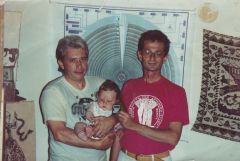
1992
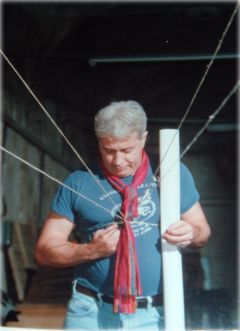
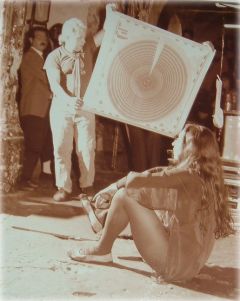
1993
New York
1995
1997
New York
2005
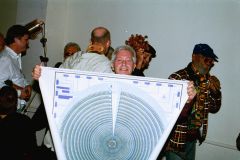

Transcript of the interview to George Chaikin made by Sandro Dernini, at Angiola Churchill's loft, New York, November 1994
It is difficult for collaborative art group endeavours to have space in old traditional exhibitions where only one person get usually credit as the creator. Recently there is a move towards more democratic forms where all people are participating in the making decisions process.
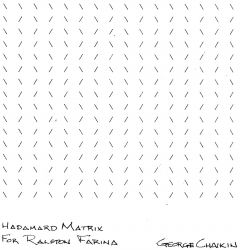
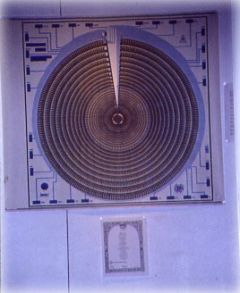
My initial understanding of Plexus Black Box through my participation, made by the art work, the Haddamard Matrix retina, a device for image compression, for reducing information, was to facilitate face to face communications among artists all over the world. Then I realized that my art work in Plexus were used by other artists, like Gaetano Brundu and Maria Grazia Medda, as a foundation for the growing of collaborative development.
My feeling of Plexus Black Box is that there is a continuous shift of what is in the box and why. I believe that its' relevance was more related with whom in that moment was participating and from the circumstances. My participation was made not under any hierarchy, because it switches always in time and space. I believed that I never was a key player. I participated without understanding what I was doing with the belief that others were understanding. Over years, as the process recurs, in retrospect, I began to understand what was happening. Sometimes I did not know what and why something was happening but, later on, it made sense. The Plexus process is a non linear activity and is less rational, in which the coherence appears only after the fact. After my experience over the years I know that there is not a need to get every "i" dotted and cross every "t" in terms of understanding it. This is because you will understand it only after you let yourself participate in it.
In Plexus the question of the balance between leadership and democracy was not relevant, and I believe myself to be a profoundly democratic person. I believe also that Plexus is a coherent democratic structure because it has not a hierarchic structure. Sandro covers his role of orchestrating it on a basis of a democratic participation.
Everybody has his/her own point view and with different art forms in which not everybody is interested in it.
Plexus Black Box was an attempt to document the history of Plexus.
My relationship with Plexus started in 1985 on the occasion of the memorial for the death of Ralston Farina, a performing artist.
Through Willoughby Sharp I met Plexus in that occasion at CUANDO. Time was gravity for Ralston holding him down. The concept of "time-art" was that art was related to time.
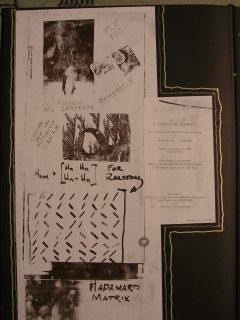
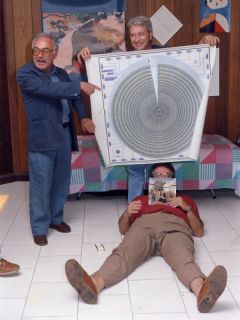
In 1985 I showed at CUANDO a large copy of the Haddamard Matrix dedicated to Ralston; in 1986 I started the mass-production of 1000 copies of it to be distributed to the audience at CUANDO through the air fan of Ralston.
In 1987 I produced an interactive telecommunication art event with Willoughby Sharp. In the same year I participated in the Symposium on the Dematerialization of Art, held at NYU-Icasa where I produced several hundred copies of my Haddamard Matrix drawing and distributed them by leaving them on the chairs of the audience. A journalist, from the audience asked to me why it was art, when it was not looked at like it was expected to be, in some customary way.
In 1988 I faxed it from NYU to Sardinia. Most of what I did was engaged with the memory of Ralston Farina and to mechanisms of perception.
I am interested in studies on aesthetic perception and divine proportion. The ultimate objective of my participation in Plexus was to facilitate communications among people, and I started to realize how I could use my model of vision, based on the sunflower model, to reduce a great quantity of information in the process of telecommunication broadcasting.
What is the Plexus Black Box and what is its function? Ritual is very important in the understanding of it by giving continuity and connecting one activity to another one.
Initially I did not like ritual but after I participated more in these activities I understood that the ritual of documentation became a significant part of Plexus by keeping in it the life of the community and bringing people together.
The ritual activities of the documentation became a form of collective joint participation in which each one gave up something in order to share in a global participation which turned to become a contemporary art form.
These ritual activities of Plexus Black Box which easily could be characterized as chaotic activities turned into a kind of art form which ended by also documenting the unity and coherence of all this chaos.
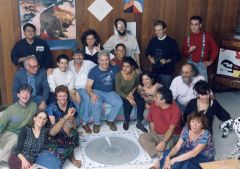
Plexus Black Box became in the end the unifying element of a collective participation in which the photo of that moment was the key ritual element of a documentation for Plexus own history.